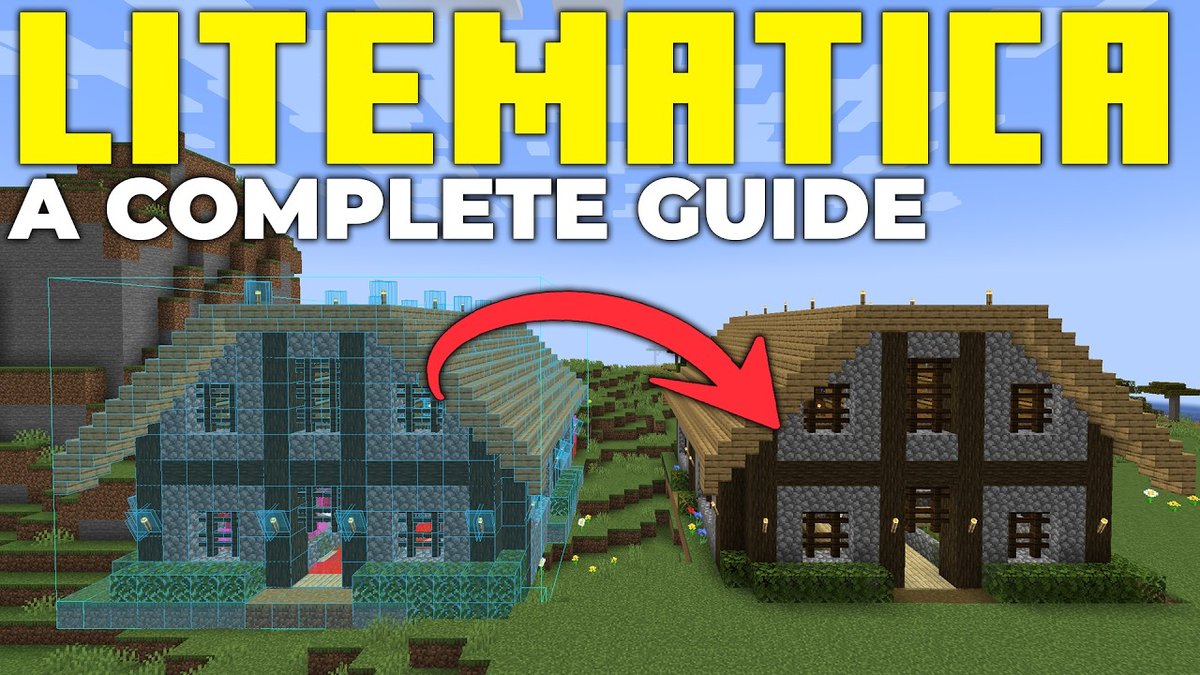
Imagine capturing your most intricate Minecraft builds—that sprawling castle, your perfectly optimized farm, or even just a particularly clever Redstone contraption—and transforming them into reusable blueprints. That's the magic Litematica offers, especially now, when you're working with the vibrant new features of Minecraft 1.21.8. This guide isn't just about technical steps; it’s about empowering your creativity by mastering the process of creating and exporting schematics in Litematica, turning any in-game structure into a portable, shareable asset.
At a Glance: Your Litematica Schematic Blueprint
- Install Litematica: First, ensure Litematica is correctly installed for your Minecraft 1.21.8 client using Forge or Fabric.
- Open Main Menu (M): Access Litematica's core functions from the main menu.
- Define Your Area: Use the
Schematica Selectiontool to precisely outline the structure you want to capture. - Save Your Schematic: Navigate to the
Schematic Manager, selectSave As, name your file, and choose a destination. - Share & Reuse: Your new
.litematicfile is ready to be loaded, positioned, and even shared with others, complete with a material list.
Why Litematica? Your Personal Architectural Assistant for 1.21.8
In the fast-evolving world of Minecraft, building epic structures or replicating complex designs can be a daunting task. That’s where Litematica shines, acting as your indispensable in-game blueprint and planning tool. It's more than just a mod; it’s a spiritual successor to tools like Schematica, rebuilt from the ground up to integrate seamlessly with modern Minecraft versions, including 1.21.8.
Litematica allows you to visualize builds as ghost images in your world, providing a step-by-step guide for reconstruction. But its power goes beyond mere display; it enables you to capture your own creations, turning them into shareable .litematic files. This is invaluable for personal projects, collaborating with friends, or simply preserving your favorite builds. If you're looking to dive deeper into everything this powerful mod offers for the latest update, you can always Learn about Litematica for 1.21.8.
Getting Started: Preparing Litematica 1.21.8 for Blueprinting
Before you can start capturing your masterpieces, Litematica needs to be properly set up on your Minecraft client. This process is straightforward, whether you're using a default launcher or a third-party option like CurseForge.
Installation: The Foundation of Your Schematics
Litematica is a client-side mod, meaning it only needs to be installed on your computer, not on any server you play on. You'll need either Forge or Fabric installed first, as Litematica is built upon these mod loaders.
For the Default Minecraft Launcher:
- Download Litematica: Head to a trusted mod repository (like CurseForge) and download the Litematica
.jarfile that specifically matches your Minecraft 1.21.8 version and your chosen mod loader (Fabric or Forge). Don't forget any required dependencies, though Litematica often pulls these in automatically via its mod loader. - Locate Your
modsFolder: Open your Minecraft Launcher, navigate to theInstallationstab, and click the gray folder icon next to your Fabric or Forge profile. This will open your.minecraftdirectory. - Place the File: Inside your
.minecraftdirectory, you'll find (or need to create) a folder namedmods. Drag and drop the downloaded Litematica.jarfile into thismodsfolder. - Launch Minecraft: Close the folders, return to your Minecraft Launcher, and launch the game using the Fabric or Forge profile you just modified. Litematica should now be active.
Using a Third-Party Launcher (e.g., CurseForge): - Open Your Modpack: Launch your preferred third-party launcher and select the modpack or profile where you want to add Litematica.
- Add More Content: Look for an option like
Add More Content,Add Mods, orBrowse Mods. - Search & Install: Search for "Litematica" (and ensure it's the correct version for 1.21.8). Click
Install. Your launcher will typically handle all dependencies automatically, making this a very smooth process. - Launch & Verify: Once installed, launch your modpack. Litematica should be ready to go.
If you ever encounter issues during this phase, remember that our in-depth guide to installing Litematica can provide more detailed troubleshooting steps and visual aids.
Initial Setup and Accessing the User Interface
Once Litematica is installed and you've loaded into a world, it's time to get acquainted with its interface.
- The Main Menu: Pressing the
Mkey opens Litematica's main menu. This is your central hub for everything from loading schematics to managing selections and configurations. - Configuration Menu: If you need to tweak visual settings, adjust overlay colors, or change keybinds, hit
M + C. This configuration menu allows for deep customization to suit your workflow. - Material List: A quick
M + Lwill bring up the Material List window, which becomes incredibly useful once you've loaded a schematic and need a "shopping list" of blocks.
Taking a moment to customize your keybinds here can save you a lot of time and frustration later, making your workflow incredibly efficient. For a comprehensive look at optimizing your controls, consider mastering Litematica's keybind shortcuts.
The Heart of the Matter: Creating Your Schematic
Now that Litematica is running smoothly, let’s get to the core task: capturing your builds. This involves carefully defining the area of your structure, ensuring every block you want to save is included.
Understanding Litematica's Selection Tools
Litematica doesn't just randomly grab blocks; it relies on a precise selection system. You'll use the Schematica Selection tool to mark the boundaries of your build. Think of it like drawing a transparent box around your creation.
Key Concept: Region Corners
A schematic selection is defined by two opposing corners of a cuboid region. You'll set "corner 1" and "corner 2" to encompass your entire build. It's crucial that these corners form a box large enough to fit everything, even if it means including some air blocks around your structure.
Step-by-Step: Defining Your Build Area
- Enter Your World: Launch Minecraft 1.21.8 and load into the world containing the structure you wish to schematic.
- Open Litematica Main Menu: Press
Mto bring up the Litematica main menu. - Navigate to Schematic Manager: Click on
Schematic Managerfrom the main menu options. This is where you'll handle all your schematic creation, saving, and loading. For a deeper dive into all the manager offers, check out our guide to the Litematica Schematic Manager. - Initiate a New Schematic: Within the
Schematic Manager, click onNew Schematic. This action tells Litematica you're about to define a new capture area. - Activate Selection Tool: Litematica automatically activates the
Schematica Selectiontool. You'll likely see a message in chat indicating this, or a bounding box might appear if you have existing selections. - Set Corner 1:
- Walk to a corner of your build (or an appropriate spot outside the build, remembering you want to encompass it).
- While holding the configured
Schematica Selectionhotkey (default often involvesAlt+ scroll wheel or specific mouse buttons, which you can configure inM+C), look at the block you want to be the first corner. - Interact with the block (e.g., right-click or left-click, depending on your keybinds) to set "corner 1." A visual bounding box may appear, indicating this corner.
- Set Corner 2:
- Move to the diagonally opposite corner of your build. Ensure you're on the other side of the entire structure from your first corner.
- Just like before, interact with the block to set "corner 2." As you set the second corner, Litematica will draw a transparent bounding box (usually red) showing the full extent of your selection.
- Pro Tip: Go a block or two beyond the actual edges of your build on all sides (and above/below) to give yourself some breathing room. It’s better to capture a little extra air than to clip off a piece of your masterpiece. Use free-cam (
F4by default if you have malilib installed and configured, or spectator mode) to get a good aerial view and ensure your selection box completely envelops your structure from all angles.
Pitfall: Overlapping Selections or Missing Blocks
- Incomplete Selection: The most common mistake is not making the selection box large enough. Always double-check that your entire build, from its lowest point to its highest, and across all its horizontal dimensions, is fully inside the red bounding box.
- Accidental Overlap: While less critical for creation, be mindful of any other existing selections you might have. Litematica generally handles this well, but it's good practice to focus on one selection at a time.
- Too Large a Selection: While including extra air is fine, don't make your selection excessively huge (e.g., an entire chunk when you only need a small house). Larger schematics take more space and can be slower to process or load.
Capturing Your Vision: Exporting Your Schematic File
With your selection precisely defined, the next step is to save it as a permanent schematic file. This is where your in-game build transforms into a portable blueprint.
- Return to Schematic Manager: After defining your corners, press
Mto open the main menu again, and clickSchematic Manager. - Select Your Active Schematic: In the
Schematic Manager, you should see your newly defined schematic listed. It might have a generic name like "New Schematic" or "Selection 1." - Choose "Save As": With your schematic selected, locate and click the
Save Asbutton. This will open a new dialog box for naming and saving your file. - Name Your Schematic: Provide a clear, descriptive name for your schematic (e.g., "MegaFarm_v2," "RedstoneDoor_compact," "MyStarterHouse_1.21.8"). Good naming conventions will save you headaches later when you have many schematics.
- Choose a Destination: Litematica will default to saving into your
schematicsfolder within your.minecraftdirectory. This is usually the best place to keep them organized. You can browse to a different folder if you prefer, but sticking to the defaultschematicsfolder makes them easy to find later for loading. - Confirm Save: Click the
Savebutton. Litematica will process the selected area and save it as a.litematicfile to your chosen location. You'll usually see a chat message confirming the save.
Understanding the .litematic Format
The .litematic file format is Litematica's proprietary schematic format. It's an efficient way to store block data, including block states, inventories, and NBT data (like mob spawners or signs with text). This means your schematics are incredibly accurate and retain all the subtle details of your original build. While older tools might use .schematic or .schem, Litematica primarily uses .litematic for its advanced capabilities.
Beyond Creation: What You Can Do With Your Schematics
Creating and exporting is just the beginning. The real power of Litematica comes from using these schematics to build, replicate, and collaborate.
Loading Existing Schematics: Bringing Blueprints to Life
Once you have a .litematic file, whether it's one you created or one you downloaded, you can load it into any world.
- Place the File: Ensure your
.litematic(or even older.schemfiles) are placed in theschematicsfolder within your.minecraftdirectory. If the folder doesn't exist, simply create it. - Open Litematica Menu (M): Press
Min-game. - Go to
Load Schematics: Click onLoad Schematicsfrom the main menu. - Select & Load: Find your desired file in the list that appears. Select it and click
Load Schematic. This makes the schematic active but doesn't immediately place it.
Precision Placement: Positioning Your Build Accurately
After loading, your schematic will appear as a ghost image, often at an arbitrary location. You'll need to position it correctly.
- Navigate to
Schematic Placements: From the main Litematica menu (M), clickSchematic Placements. - Configure Your Loaded Schematic: Find your loaded schematic in the list and click the
Configurebutton next to its name. - Adjust Position:
- X/Y/Z Controls: Use the increment/decrement buttons next to X, Y, and Z to nudge the schematic by individual blocks or larger increments. The
Yaxis is particularly important for vertical alignment. - Rotate: The
Rotatebutton allows you to spin your schematic around the Y-axis (horizontal plane) in 90-degree increments, which is vital for aligning it with your build space. - Move to Player: This is a fantastic shortcut! Click
Move to Playerto instantly snap the schematic's origin (its0,0,0point) to your current location. You can then fine-tune it with the X/Y/Z controls. - Mirroring: Depending on your Litematica version and specific configuration, you might also have options to mirror the schematic along an axis.
- Hotkeys for Fine-Tuning: Remember that many of these placement adjustments can also be done via hotkeys, allowing for incredibly fluid in-game positioning. For a deeper dive into optimizing your workflow with advanced placement features, check out our Litematica placement advanced tips.
The Material List: Your Essential Shopping Guide
Once a schematic is loaded and positioned, the next natural step is to gather the resources needed to build it. Litematica makes this incredibly easy.
- Access the Material List: Simply press
M + Lto open the Material List window. - Your Shopping List: This window provides a comprehensive breakdown of every single block and item required to build the loaded schematic. It categorizes blocks, counts them, and even shows you how many you are "Missing" if you have items in your inventory.
- Real-time Tracking: As you place blocks, Litematica dynamically updates the material list, showing your progress and what you still need. This takes the guesswork out of large builds, making resource management a breeze.
Troubleshooting Common Litematica Queries
Even with the best instructions, questions can arise. Here are quick answers to some frequent Litematica issues:
- "My schematic isn't showing up after loading!"
- Check Placement: It's likely loaded but far away. Go to
M -> Schematic Placements, select your schematic, and useMove to Playerto bring it to your location. - Visibility Toggle: Ensure the schematic's visibility is enabled in the
Schematic Placementsmenu (there's usually a toggle button or checkbox). - Layer Visibility: If you're using layers, ensure the current layer you're on (or all layers) are set to visible.
- "How do I change keybinds?"
- Press
M + Cto open the Configuration Menu. Navigate to theHotkeystab. Here you can reassign any Litematica keybind to better suit your preferences. - "Do I need Litematica on my server to use its features?"
- No. Litematica is a client-side mod. This means it only needs to be installed on your local Minecraft game client. It doesn't need to be on the server for you to use its display, placement, creation, or export features. This is a huge advantage for multiplayer servers where you might not have control over server-side mods.
- "My game crashed after installing Litematica!"
- Version Mismatch: Double-check that your Litematica
.jarfile, your mod loader (Forge/Fabric), and your Minecraft version (1.21.8) are all perfectly compatible. - Dependencies: Ensure you have any required dependencies (like
malilibfor Litematica) installed alongside Litematica. The mod page usually lists these. - Corrupted Download: Try redownloading the
.jarfile from a trusted source. - If you're still stuck, refer to our comprehensive Litematica troubleshooting tips for more advanced solutions.
Elevating Your Builds: Best Practices for Litematica Mastery
With the technical aspects covered, let’s talk about how to make Litematica an even more powerful tool in your creative arsenal.
- Organize Your Schematics Folder: Don't let your
schematicsfolder become a chaotic mess. Create subfolders for different projects, world saves, or categories (e.g., "Redstone," "Farms," "Houses," "Community Builds"). A well-organized library makes finding and reusing schematics a joy, not a chore. - Name Schematics Clearly: "House_final_final_v3" isn't a great name. Opt for descriptive names like "StarterFarm_melon_auto_1.21," "Mansion_Stonebrick_SouthWing," or "XP_MobGrinder_Enderman." Include version numbers or key features in the name.
- Test Your Schematics: Before sharing a schematic or relying on it for a huge build, load it into a creative test world. Ensure all blocks are captured correctly, NBT data is preserved (especially for chests, command blocks, signs), and there are no missing elements.
- Back Up Your Schematics: Like any valuable digital asset, back up your
schematicsfolder regularly. A simple copy-paste to a cloud drive or external hard drive can save hours of rebuilding if your local files ever get corrupted. - Utilize Selection Presets: For frequently used selection sizes or shapes, explore Litematica's ability to save selection presets. This can speed up the area-defining process significantly for repetitive tasks.
Your Next Big Build Awaits
Creating and exporting schematics in Litematica 1.21.8 isn't just a technical exercise; it's a gateway to limitless creative possibilities in Minecraft. You're no longer limited to single-instance builds. With your newfound ability to capture, export, and redeploy any structure, you gain a powerful tool for personal projects, collaborative efforts, and the joy of sharing your architectural ingenuity with the wider Minecraft community. So, go forth, build your dreams, and let Litematica be the blueprint for your greatest adventures yet!